
Bayonetta
Originally published at YourHealthisLow
Bayonetta
Posted by Sharon on March 3, 2010 · Leave a Comment

It’s All About the Timing
A look at Bayonetta.
Sega’s action title, Bayonetta, released in North America in January of 2010 for the 360 an PS3, made it’s way to consoles everywhere after a thorough and effective marketing campaign. Made increasingly popular by her appearance at major events in ’09, our glasses toting heroine seemed to exemplify the sex appeal necessary to grab the attention of, well, everyone. Intrigued by this new work from Devil May Cry designers, the title was a hit with early reviewers, furthering the hype.
Bayonetta, however, had this black haired glasses toting reviewer reflecting upon her time with this witch with some conflicting inner emotions.
The largest obstacle to overcome in this sega game was by and large Bayonetta herself. Not only is the design of the character so extreme, taking proportions to entirely new levels, her smug personality seemed to waver between tired and sad. Throughout the plot Bayonetta is subject to flashbacks, used to help merge the two converging story lines of past and present, as we try to determine how it relates to the good vs evil plot and why our protagonist seems to be caught somewhere in the middle. The flashbacks make an attempt to reveal a small portion of the story in each and every segment, and often leave our character stunned, like a deer in headlights, giving her a moment of intellectual emptiness while her attempts at humor are usually misinterpreted as arrogance.
All of the elements needed for a strong female lead are present. The *potential* for a really stylistically kickin’ character is there, but in this player’s opinion Bayonetta is so over the top that the abundance of T&A can not save from the frustrations that is Bayonetta herself, and can not keep me from the desire to hurl her into a pit of fiery lava. Yes, I may have done so a few times. On purpose.
 Bayonetta gets her hands on a killer chainsaw!
The controls of the game are loose and easy to learn with only the minor inconvenience of awkward camera movements and imposing objects that altogether block the view of any given battle. Attack combinations are fluid and can be as precise, or not, as the gamer implementing them. While the attack combos are easy and sometimes astoundding, often times some old fashioned button mashing can be just as successful, removing some of the legitimacy of taking the time to learn the combos in the first place.
As you play through the game you are faced with the ability to ‘buy’ new moves, each with an increased amount of usefulness as you face stronger and larger enemies. Your basic kick punch combinations are easy combat staples and the interchangeability of them allow for varying degrees of skill and fun. Dodging and counter attacks are effective in ground and air battle and as you gain more magic, you are better able to control the use of these attacks. The combat is compelling and there are some fantastic weapon elements that keep the combat fun and intense. Enemies can prove to be challenging but as with all the challenging elements of this game, it’s all about the timing.
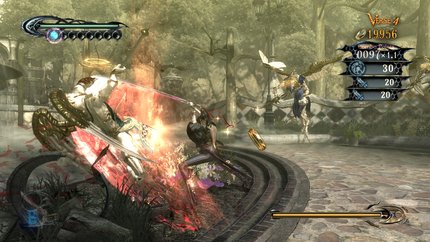
Throughout Bayonetta, there is a rhythm to each world and character and discovery of this rhythm is what often determines your successful interaction with them. From well timed motorcycle jumps, to dodging enemy fireballs, to the utilization of your witch power to sprint across water or release the beast within, every aspect of the game can be solved rhythmically. The rhythm of the game is part of what propels the player forward.
The story of Bayonetta is presented in a quirky and heavily stylized way; giving the feel that you are playing a comic book. Story summaries and plot progression is presented in a combination of cut scenes and still frames. Some cut scenes included no movement of character, but used slight zooms and pans while images remain static. Each segment of story telling was given great attention to composition; dynamic lighting and angles which furthered the graphic novel feel of this game. The unfortunate side effect of introducing still frames and comic book like cut scenes is the director’s use of the “film strip” graphic. Used as a border and as a point of transition, the intended humor behind the use of this graphic element was distracting at times, but quickly gives way as you find yourself ready to fend off a “Joy” and your frustrations are redirected.
Bayonetta faces a myriad of enemies throughout the game, and boy, are they cool! From the ‘Beloved’ to ‘Harmony’ and right to the ‘Temperantia’ the design of these characters is well executed and engaging. This is where the game holds its merit. Bayonetta is a nice looking game. The graphics are great! The color is rich and vivid, the light is interactive and the styles are appropriate as the character changes from place to place. There are contrasting environments which change the drama and pace of the game as well as the story telling; building upon suspense or departing from it as is appropriate. In some chapters of the game your character, our heroine, is not bound by universal laws of gravity and by exploring this we are able to see just how much of the environment has been rendered. The environments are so inviting at times as to lure one towards some of the many invisible walls.
 Temperantia
The inventory system is also well placed, with items easily obtained and kept. By travelling through the gates of hell Bayonetta is able to purchase weapons, items, moves and other requirements. Purchases are made by the use of ‘halos’ as currency. Eerily similar in appearance to that of some Sega ‘rings’ you may have collected in the past, the halos are dispensed from enemies as they meet their ultimate demise. There are many options to collect special items which make for special weapon trades once through the gates of hell. Bullets collected throughout the environments allow for some extended mini game fun while your next chapter loads.
The music makes an attempt to reiterate the underlying sense of humor that the game portrays and often acts as comic relief during some intense moments of battle. While the mood seems somewhat forced throughout most of the game, the level of bother this causes diminishes as you become more engaged in the game play, plot development, and your enemies; only to be reminded on occasion during the slower paced areas of the game. The sound effects are appropriate and believable given the context and the voice acting is as would be expected. The characters are represented in a dramatic over the top way and but are done well and the actors surely are not first time voice actors. Bayonetta is portrayed by actress Helena Taylor, Luka by Yuri Lowenthal and Cereza by Stephanie Sheh.
Bayonetta, has some very compelling qualities. The game is beautiful, it has mainly enjoyable combat, the enemy and environment design are intriguing and the acting is satisfying. Where the game falls short is in an unimaginative plot line, forced humor, and sometimes inappropriate use of music. Where the game ceases to impress is in its overt sexuality; not adding to the empowerment of our female protagonist but instead setting her, and female leads after her, backward. If you enjoy this game the first time around, it will lend itself to great replay value. But for me, this glasses toting heroine is going to keep searching for a game with a satisfying female lead experience.
 This game is rate M for Mature.

Call of Duty: World at War (Nintendo DS)
Originally Published at YourHealthisLow

Call of Duty: World at War for the DS (herein referred to as W@WDS) is Activision’s handheld translation of the mega hit released on PC and all current gen consoles. The DS version of the release was developed by n-Space and released in November of ‘08. This take on the FPS can be picked up at low-cost from most game retailers.
In an overcrowded market of first person WWII games, the Call of Duty franchise has historically stood above and beyond the line of competitors praised for multiplayer, battle representation, and the esthetic appeal we’ve come to expect. So how does this translate to the handheld version of the second best-selling game of ‘08?
W@WDS begins with a brief training session in which the user is introduced to the navigation and controls that the DS has to offer. The stylus is used for movement of vision, the directional pad navigates the character around the map, while the L button fires weaponry. The controls are challenging to get used to at first, but come with more ease as you continue through the game.
As you and your squadron work to defeat the Japanese and inevitably make your way to securing the castle, you get to understand the enemies and the best way to approach them. Generally, your crouch and cover method is a practice in patience that leads to each battle’s success. The story continues by offering some British POV missions before returning to one of our initial protagonists Dimarkurato.
Each battle is fought with relative ease allowing for satisfaction in gaining achievements as you meet certain criteria during gameplay. Your squadron acts as support and guidance during the game and is full of visual and verbal ques. The voices portraying your squadron are assertive, direct, and to the point, while the music and sound are what make the game more engaging.

The game has a surprising level of complexity and includes some interesting uses of the stylus. In small side tasks necessary for completing missions such as the disarming of land mines and transmission of mores code, you are inadvertently subjected to slower, suspense building moments, usually following a battle. The war room is used to track statistics and achievements and is accessible through the main menu while your inventory appears in the touch screen of the DS along with a Plainview map.
One of the most disappointing aspects of the handheld release of this widely renowned title has to be the multiplayer aspect. The multiplayer short fallings comes not from the multiplayer gameplay itself but rather from the fact that to find ANY W@WDS players on the DS’s WIFI system is next to impossible. IF you are able to link up with your friends to play, you will not be disappointed, but you will neither be impressed, unless of course you have never played a PC or console FPS multiplayer game before.

So what is the appeal of the portable FPS?
Understanding the desire to release the title on all platforms and thusly being available to potentially every gamer out there, one can not help but feel that this is one of those situations in which the genre does not translate. Of the FPS’s available on the DS, the Call of Duty franchise has done it justice with this title World at War but lost in a sea of sim games, puzzle games, RPGs and niche market releases, it seems the FPS player is not quite the DS demographic.
With a long history of FPSs, it is hard to compete with the intensity, atmosphere, superior graphics and over all experience of the PC, and increasingly, the console first person shooter encounter. The very nature of the point of view play lends itself more naturally to large screens, loud speakers and online or LAN multiplaying experiences that can not be duplicated in a hand-held device. Having stated the above, Call of Duty World at War for the DS is a formidable translation of the FPS genre and one that can be taken on the travel. This game is currently inexpensive and a solid gaming experience worth a pick up for any adult gamer, but perhaps not the dedicated FPS gamer, who perhaps isn’t likely to own a DS.

Scribblenauts: DS
Originally published on YourHealthisLow

Scribblenauts, developed by 5th Cell and published by WB, released in September 09, was one of the most anticipated DS titles of 09. Large buzz surrounding the game made its way around the internet boasting innovation and hours of action/puzzle fun.
 Scribblenauts for the Nintendo DS
The game finds out hero, Maxwell, clad in the famous rooster hat that was widely popular with gamers who preordered the game, in a variety of situations in which he needs to reach a ‘starlite’ to complete each level. The levels are available in two modes, action mode and puzzle mode and increase in difficulty. The level creator is available for those who feel compelled to create their own levels and challenges, increasing the number of playable levels beyond 210. The WiFi connection allows you to share your created levels with friends.
The game’s appearance is heavily stylized and satisfyingly simplistic. With the whimsical characters, backgrounds and environments, items are clear and concise in a palette of colors that is flat, vivid and bright.

The music is just as whimsical as the appearance of the game and the exaggerated sounds give a glimpse into the humorous possibilities that the unique engine provides.
The most notable and talked about game play feature is the ability for the player to create items for Maxwell to use in his efforts to complete each level. As you play through the levels your ingenuity becomes more and more important and points are awarded for new items used and other factors. The title screen is used as a playable open world in which you can select your setting and create as many items and other characters as you like, creating a wide variety of scenarios to be played out. One of my favorite title screen moments was the ultimate pit of a ninja riding an ostrich who bravely fought my cow riding pirate. There are countless combinations and hours of random fun that can be explored in this seemingly endless library.

Overall Scribblenauts is a fun, unique and light-hearted DS experience that brings out the creativity in the player, or lack there of. Unfortunately the game lacks the addiction factor that some other puzzle/action games do so well and after the novelty of the specific gameplay features wear off, one does not feel compelled to return to the levels.
Scribblenauts is a great game for you if you enjoy a good giggle or like to test the abilities of your brain’s right side. Sharing ridiculous scenarios you have played out in Scribblenauts with your friends and cohorts is one of the great after effects of adding this game to your DS library.

The Facebook Platform
First published on YourHealthisLow
The Facebook Platform
Posted by Sharon on February 15, 2010 · 2 Comments

The Facebook Platform
On February 4th 2010, Facebook turned 6 years old. Well past infancy, and worlds beyond toddler, your cute little social networking site is a big boy now. With 400 million registered users and 200 million users active on any given day, Facebook has exploded into daily life as acceptably as the internet itself. In six years Facebook has grown from localized use to become a world wide networking application available to everyone on almost all media devices, even XBL introduced its new social networking partnership in 09.
 Facebook on Xbox Live
Given the popularity of the site and those who use it, you may find an increase in the number of people talking about and playing the newest social networking game. Even parents and *gasp* grandparents are finding themselves spending countless hours on animated farms, cafes and amusement parks.
Playfish, who was recently acquired by Electronic Arts for approximately US$300 million, states on playfish.com that they want social network games to be the part of your life that poker night, bowling or board games once were. “At Playfish we believe social games are a big part of the future of the video games industry, and are working hard to be the leading company in this emerging sector.”
While the people at SGN claim “Connectivity is key” and they hope that by “bringing people as well as game developers together [they will] lead the way toward a more meaningful and socially engaging future.”
 Cafe World
With such a captive and built in audience it is a no wonder developers are utilizing Facebook as a testing ground for all kinds of developments. The ability to track the demographics of this new gamer so specifically is a vastly appealing market research tool. As with any product, understanding your audience is key in developing and refining a successful product.
Michelle, a 29 year old mother of one says she spends approximately one half hour per day playing Facebook Mafia Wars, Cafe World, and Farmville. Michelle feels that Facebook games “are just boredom fillers” and that they “are really not interesting enough” to carry the demographic over to console releases of the games.
Electronic Arts however seems to be making it’s best attempt at crossing the line and opening up a world of possibilities for Facebook gamers by bringing big titles to the social network platform. Most notably, Need For Speed Nitro, released on Facebook in late November 09. Nitro has the expected excitement of the regular title while reaching an audience that “exceeds the total number of users for World of Warcraft and Xbox Live combined,” according to Sande Chen of Gamasutra.com who sites Gareth Davis, Platform Program Manager at Facebook, as saying that “the number of users World of Warcraft has collected over four or five years is equal to the number of new sign-ups to Facebook each month.”
 Using Facebook to sell NFS Nitro on the WII and DS
So what types of games are we seeing on Facebook?
Sim games, games like Farmville and Café World seems to be dominating the news feed, while one can not help but notice a surprising rise in MindJolt games which include arcade, puzzle, strategy and sports games.
We can draw some comparisons between the Facebook games of today and the games that got us first addicted decades ago with one important difference. Social networking games, on Facebook specifically, are free or almost free in the world of downloadable apps.
So as we see Facebook continue to be the critical social networking power house it has become, so shall we see the development of social networking games and the demographic of people who play them. We will also note carefully the growth of Facebook games to reach a new level of quality while expanding into more genres, getting to know you, the consumer, and better understand what type of gamer you are or will become.
Does this mean that mom will make the transition from party games, puzzle games and real time games such as Farmville, Café World and others and jump into a Final Fantasy type RPG or Platform game? Probably not, but Facebook along with innovative developers such as EA, SGN and Zynga may be well on their way to bridging the gap to create a new type of video game player, further bringing video games into the daily lives of everyone.

 MyaSharona.com